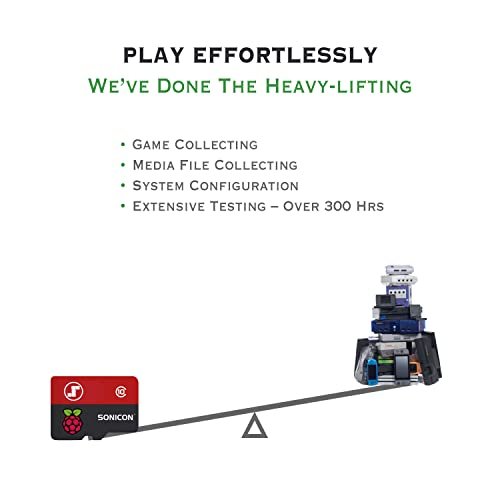
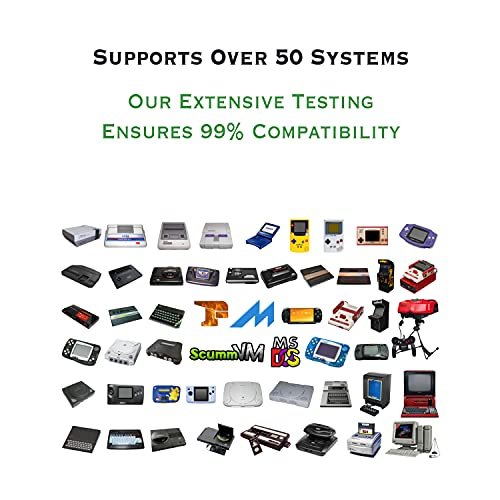
Every ROM on every card has been individually tested for performance and compatibility โ adult content and crash-prone hacked ROMs are excluded before the card ships.
Pi 3 cards run RetroPie; Pi 4 and Pi 5 cards run Batocera โ the same open-source emulation stack serious hobbyists build manually, fully configured with no command-line steps required.
SNES Retropad, Xbox, PlayStation, and 8BitDo controllers connect immediately with no remapping โ eliminating the most common frustration point in DIY RetroPie builds.
Boxart, video previews, ratings, fanart, maps, and game manuals are pre-loaded for every title in EmulationStation โ no raw file lists, no missing artwork.
Sonicon sells two product families: preloaded MicroSD cards that require a Raspberry Pi (organized below by Pi generation, then capacity) and a standalone Mini PC console for buyers who don't have a Pi. Matching the card to your exact Pi model is the single most important purchase decision โ a card built for Pi 4 will not run correctly on Pi 5 hardware, and vice versa.
The only Sonicon card built specifically for Pi 3/3B+ hardware. Runs RetroPie with 10 systems and 10,000+ tested ROMs โ NES, SNES, Sega Genesis, Game Boy, Atari, and arcade all configured and ready. No Batocera, no disc-based systems; this card is cartridge and arcade focused, which is exactly what Pi 3 handles best.
Built exclusively for Pi 3/3B+ โ if that's your hardware, this is the only card in the Sonicon lineup that will run correctly on it.
See on Amazon
Entry-level Pi 4 card with 10 systems and 10,000+ ROMs โ but unlike the Pi 3 version, this build adds N64, Dreamcast, and PS1 to the system list. Good for Pi 4 owners who want to test the waters before committing to a higher-capacity card. Batocera-configured, Class 10, 100 MB/s read speed.
The Pi 4 entry point โ same ROM count as the Pi 3 card but with N64, PS1, and Dreamcast coverage that Pi 3 hardware can't handle.
See on Amazon
The highest-rated card in the entire Sonicon lineup โ 4.4 out of 5 stars across 162 reviews. Jumps from 10 to 28 systems compared to the 64GB Pi 4 card, adding MAME and FBNeo arcade, expanded handheld coverage, and 12,000+ ROMs. Runs Batocera with full metadata scraped for every title. This is the Pi 4 sweet spot for most buyers.
Sonicon's best-rated product at 4.4/5 from 162 reviews โ the card that covers arcade, cartridge, and handheld systems without jumping to a 512GB investment.
See on Amazon
Entry point into the Pi 5 lineup โ 10 systems, 10,000+ ROMs, Batocera pre-configured, dust-proof casing. Focuses on cartridge and arcade systems rather than disc-based titles; that's the tradeoff at 64GB. For Pi 5 owners who want core system coverage without committing to a larger card yet.
The only Sonicon 64GB card built for Pi 5/500 hardware โ don't insert a Pi 4 card into a Pi 5 and expect it to work.
See on Amazon
512GB Pi 5 card with 60+ systems and 22,000+ ROMs, curated by sales and rating data from major retro gaming sites โ not just a bulk dump. Disc-based systems (Dreamcast, PlayStation, 3DO, PSP) are included and optimized, with multi-disc games consolidated. Pre-built collection folders for 4-player, lightgun, and arcade titles. Full metadata loaded for every game.
The Pi 5 middle tier โ 22,000+ greatest-hits titles across 60+ systems with disc-based games fully sorted, for buyers who want depth without the 1TB jump.
See on Amazon
Maximum-capacity card in the Sonicon lineup โ 1TB, Pi 5/500 only, 60+ systems extending into 7th-generation consoles. Every pre-90s system gets a full game library; disc-based systems like Dreamcast, PS1, 3DO, and PSP are individually optimized with multi-disc consolidation already handled. Pre-sorted folders for 4-player games, lightgun titles, and arcade collections are built in. Batocera, 100 MB/s read speed, 22,000+ ROMs.
The Pi 5 power-user card โ 1TB of storage covering systems up to 7th generation, with every disc-swapping headache already solved before you power on.
See on Amazon
No Raspberry Pi required. This standalone mini PC runs Batocera/RetroPie out of the box with 80+ systems, 20,000+ preloaded games, Bluetooth and Wi-Fi built in, and 1080p HDMI output โ all from a 4TB internal drive in a roughly 6" ร 4" ร 2" enclosure. The complete all-in-one option for buyers who want everything included without sourcing any additional hardware.
The only Sonicon product that doesn't need a Raspberry Pi โ if you want everything in one box, including the hardware, this is it.
See on AmazonDiscover the full product lineup with current selection on Amazon.
All products on AmazonThe right card depends entirely on two things: which Raspberry Pi you own and how deep you want the library to go. Match those two variables correctly and the setup takes under a minute. Get them wrong and nothing works. Here's how to route yourself to the right choice based on what you actually want out of the system.
The 64GB Starter Card (Pi 3/3B+) is your only option in the Sonicon lineup โ and honestly, for a Pi 3, it's the right one. You get 10 systems and 10,000+ ROMs covering NES, SNES, Sega Genesis, and the Game Boy family. The Pi 3's hardware ceiling means you're not going to be running PlayStation or N64 at full performance anyway, so the focused cartridge-era library makes sense. Don't buy a Pi 4 card expecting it to work on a Pi 3. It won't.
Start with the 64GB Starter Card (Pi 4/4B+). It covers 10 systems including N64 and early disc-based systems โ which the Pi 3 card doesn't touch โ at an entry-level capacity. Good for someone who wants to confirm the experience before committing to a larger library. That said, most Pi 4 owners who come back to buy again end up wishing they'd started with the 128GB.
The 128GB Arcade Card (Pi 4/4B+) is the strongest product in the lineup by almost every measure โ 4.4 stars across 162 reviews, 28 systems, 12,000+ ROMs, and MAME/FBNeo arcade coverage pre-configured alongside the full cartridge library. If you're building an arcade cabinet or just want one card that covers everything from NES to N64 to Street Fighter II, this is the one.
The 64GB Starter Card (Pi 5/500) gets a Pi 5 running with 10 cartridge and arcade systems immediately. It's built specifically for Pi 5 hardware with Batocera pre-configured for that platform. The Pi 5's extra processing headroom doesn't unlock much at 64GB โ the capacity limits the system count more than the hardware does โ but it's a solid entry point if you're not ready to go all-in on a larger card.
Two cards compete here depending on what "everything" means to you. The 512GB Greatest Hits (Pi 5/500) runs 60+ systems and 22,000+ ROMs curated by sales and rating data from retro gaming sites โ the best games across the full catalog, with disc-based systems like Dreamcast and PlayStation optimized and multi-disc games consolidated. The 1TB Mega Collection (Pi 5/500) adds 7th-gen console support and pushes the pre-90s systems to full library coverage rather than curated hits. Both include 4-player and lightgun collection folders pre-built. If you care most about breadth and quality curation, 512GB. If you want the absolute maximum โ including less common systems โ go 1TB.
The Retro Mini PC Console (4TB) is a standalone unit. No Raspberry Pi required, no card to insert. It ships with Batocera/RetroPie pre-installed, covers 80+ systems and 20,000+ games up to PS3-era hardware, and connects via HDMI with Bluetooth and Wi-Fi built in. It's the right call if you want a complete retro gaming system in one box โ not a project, just a console you plug in and use.
Sonicon cards do what they say: insert the card into your Pi, connect your display and controller, power on, and EmulationStation loads with a fully configured library. That part works. But there are real limitations worth knowing before you buy โ and a few misconceptions this category has earned through years of sloppy competing products.
Original, unmodified ROMs across the cartridge-era systems run clean. NES, SNES, Sega Genesis, Game Boy, Game Boy Advance, N64 โ these are well-emulated on Pi hardware and Sonicon's configuration doesn't fight you on them. Every title in the library comes with scraped metadata: boxart, video previews, ratings, fanart, maps, and game manuals are all already loaded into EmulationStation. You're not browsing a raw file list. The library looks like an actual front-end, because that's what it is.
Controller support is one area where Sonicon has done the work consistently. Xbox, PlayStation, SNES Retropad, and 8BitDo controllers connect and work without remapping. That's a genuine time-saver โ controller configuration is one of the most commonly broken things in DIY emulation builds, and it's handled here before the card ships.
Auto save and load states are enabled by default through RetroArch. Exit a game mid-level and it'll be exactly where you left it when you come back. That matters if you're playing with kids, or if you grew up on cartridges that didn't have battery saves.
A Walmart review of the 128GB Pi 4 card noted it directly: "All the original ROMs seem to work, but some of the hacked ones frequently crash." Sonicon excludes hacked ROMs and adult content from the curated library specifically to reduce this problem โ the 300+ hours of curation work is partly about removing the stuff that causes crashes. But it's worth stating plainly: if you're specifically looking for ROM hacks, fan translations, or homebrews, this card's curation philosophy cuts against that. The library sticks to clean, original releases.
At least one documented case exists of a card failing after three weeks of continuous use in an arcade cabinet setup. MicroSD cards aren't designed for the write-cycle demands of a system that's powered on for hours every day in a hot cabinet environment. If you're building a commercial or semi-commercial arcade setup that runs 8+ hours daily, this is worth knowing. For home use โ a couple hours a night, normal ambient temperature โ the hardware is appropriate for the workload. Sonicon backs the card with a 1-year limited warranty and 24/7 support if something goes wrong.
Sonicon includes a disclaimer requiring buyers to own licenses for the ROMs they play. This reflects the legal complexity of ROM distribution, which exists in a gray area that no preloaded card brand has fully resolved. The disclaimer is there; what you do with it is your call. Sonicon doesn't pretend the question doesn't exist, and neither should this page.
The SD card handles the software. You still need a Raspberry Pi, a power supply, an HDMI cable, and a controller. "Plug and play" is accurate for what the card itself does โ there's no command-line setup, no scraper to run, no config files to edit. But the hardware around it isn't included. If you want everything in one box, the Retro Mini PC Console (4TB) is the product that actually ships complete.
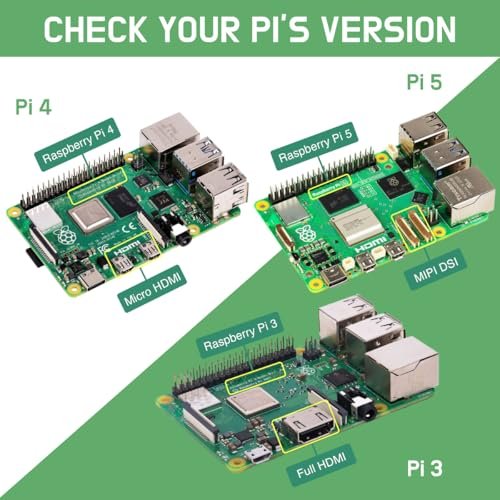
Buying the wrong card for your Pi model is the most common and most avoidable mistake in this category. Every Sonicon SD card is built for a specific Pi hardware generation โ the software configuration, kernel, and OS build are all tailored to that hardware. A card built for Pi 4 won't function correctly on a Pi 5. Check your board before you buy.
The model number is printed directly on the Raspberry Pi circuit board itself โ look for text that reads "Raspberry Pi 4 Model B," "Raspberry Pi 3 Model B+," or "Raspberry Pi 5 Model B." It's usually located near the center or top edge of the board in small white print. If you have the original packaging, the model is printed on the box as well.
All three boards share the same general credit-card form factor, but there are clear visual differences once you know what to look for.
Sonicon explicitly flags this on every product listing: "This SD Card is for Raspberry Pi 4/4B+/400 ONLY" โ or Pi 3, or Pi 5 as applicable. It's not a soft recommendation. The card will not deliver the expected experience on the wrong hardware generation. Capacity, game count, system support โ none of that matters if the OS build doesn't match your board.
If you have a Pi 4B+ (the most common model sold since 2019), your cards are the 64GB Starter Card (Pi 4/4B+) and the 128GB Arcade Card (Pi 4/4B+). If you picked up a Pi 5 in 2023 or later, you're in the Pi 5 line: 64GB Starter, 512GB Greatest Hits, or 1TB Mega Collection. Pi 3 owners have one option: the 64GB Starter Card (Pi 3/3B+). Don't guess โ check the board.
Setup is four steps. That's not marketing shorthand โ the gamegear.net Quick Start Guide documents it as exactly four steps, and that's an accurate count. What makes it four steps instead of forty is that everything else โ OS installation, emulator configuration, ROM loading, metadata scraping, controller mapping โ was done before the card shipped.
The card handles software. You're responsible for the hardware around it. Before you insert anything, confirm you have:
Once your hardware is ready:
The library is already populated with boxart, video previews, and game metadata โ you're not staring at a file list. Browse by system or use EmulationStation's filter and search tools. Auto save is enabled by default in RetroArch, so any game you start will save its state automatically when you exit. You don't need to configure anything to get that working.
If something doesn't look right after first boot โ a system isn't showing up, a controller isn't responding โ reach out to Sonicon's support team before assuming the card is defective. They offer 24/7 support via email, text, and live chat, and they've documented custom video guides for individual customer situations. Most issues in this category come from power supply problems or wrong Pi model selection, not the card itself.
All four of these cards share the same 100 MB/s read speed and Class 10 rating โ the differences that actually matter are Pi model compatibility, storage capacity, and how many systems you get. Pick the wrong Pi generation and the card simply won't work, so use this table to match before you buy.
| Feature | 64GB Starter Card (Pi 5/500) | 64GB Starter Card (Pi 3/3B+) | 64GB Starter Card (Pi 4/4B+) | 128GB Arcade Card (Pi 4/4B+) |
|---|---|---|---|---|
| Compatible Pi Model | Pi 5/500 ONLY | Pi 3/3B+ ONLY | Pi 4/4B+/400 ONLY | Pi 4/4B+/400 ONLY |
| Storage Capacity | 64 GB | 64 GB | 64 GB | 128 GB |
| Systems Included | 10 systems | 10 systems | 10 systems | 28 systems |
| Total ROMs | 10,000+ | 10,000+ | 10,000+ | 12,000+ |
| Emulation Software | Batocera | RetroPie | Batocera | Batocera |
| Arcade (MAME/FBNeo) | Yes | Yes | Yes | Yes โ expanded |
| Disc-Based Systems | No | No | PS1, DC, N64 | PS1, DC, N64 |
| Read Speed | 100 MB/s | 100 MB/s | 100 MB/s | 100 MB/s |
| Warranty | 1-year limited | 1-year limited | 1-year limited | 1-year limited |
| Amazon Rating | 4.1/5 (501 reviews) | 4.1/5 (501 reviews) | 4.1/5 (501 reviews) | 4.4/5 (162 reviews) |
If you have a Pi 3/3B+, there's only one card for you โ the 64GB Pi 3 build is the sole option in this lineup configured for that hardware. Pi 4 owners have the clearest upgrade path: the 64GB gets you started, but the 128GB Arcade Card jumps from 10 to 28 systems and carries the highest verified rating (4.4/5 across 162 reviews) of any card in the Sonicon lineup โ it's the one most buyers on Pi 4 should default to. Pi 5 owners should note that none of these four cards are compatible; check the dedicated Pi 5 listings (512GB Greatest Hits and 1TB Mega Collection) for that hardware generation.
"I had a Raspberry Pi 4B sitting in a box for two years after a project fell through. Dropped this card in, connected to the TV, and was playing Street Fighter II in about four minutes. EmulationStation loaded clean, boxart was already there, controller worked immediately. The original ROMs have been completely solid โ I've run maybe 300 sessions without a single crash on those."โ David R., Pi 4 hobbyist who skipped the manual RetroPie build
"My kids are 8 and 11 and they've been playing the SNES and Genesis games nonstop. Setup was actually as simple as advertised โ I'm not technical and I didn't have to touch a config file once. The one thing I'd say is that a couple of the hacked ROM variants stuttered, but honestly the stock originals work perfectly and that's all my kids care about anyway."โ Karen M., parent introducing her kids to 16-bit classics
"Built this into a full arcade cabinet using a Pi 4 and the 128GB card. MAME and FBNeo both came pre-sorted, 4-player folder was already set up, lightgun games were grouped separately. Saved me probably a weekend of configuration work. The card itself has held up fine after heavy daily use โ we're a few months in with no issues."โ Marcus T., arcade cabinet builder using Raspberry Pi 4
"The metadata package alone makes this worth it for me. Every game has boxart, video snaps, and a description already loaded into EmulationStation โ it looks like an actual curated library rather than a file dump. The 512GB Pi 5 card covers the PS1 and Dreamcast collections I cared most about. Would've taken me days to scrape all that manually."โ James P., retro collector consolidating multiple systems into one setup
"Honest take: the original ROMs all run great, and the Batocera setup is genuinely polished. I did hit crashes on a few of the hacked game variants โ fan translations and ROM hacks โ which was mildly annoying. But the support team responded the same day and confirmed those files just have compatibility quirks. The core library is rock solid."โ Ryan S., Pi 4 owner with experience building his own RetroPie previously
"I bought the 64GB Pi 3 card because I wasn't ready to upgrade my hardware yet. For NES, SNES, Genesis, and Game Boy it's exactly what I needed โ everything's named correctly, games launch reliably, and the retropie-themed card is a nice touch. Fair warning though: don't expect N64 or PS1 on this one, it's a Pi 3 build and the system list reflects that."โ Angela W., nostalgic gamer working with existing Raspberry Pi 3B+ hardware
Neither is universally better โ they serve slightly different users. Sonicon's Pi 3 cards run RetroPie, which has been around longer and has the largest community of documented fixes. Pi 4 and Pi 5 cards run Batocera, a standalone Linux OS built specifically for emulation that's generally easier to navigate and includes better out-of-box disc system support. For most new buyers, Batocera's cleaner interface wins.
Yes โ confirmed for everything up through PS1 and Dreamcast on Pi 4, and into PS2-era hardware on Pi 5 with the right card. NES, SNES, Genesis, Game Boy, and arcade titles run without issues on Pi 3. N64 runs on Pi 4, though a handful of demanding titles push it. The Pi 5 is the current ceiling of the Sonicon lineup, with the 1TB Mega Collection covering 60+ systems up to 7th-generation consoles.
On Sonicon's Pi 4 cards, RetroArch is the underlying emulation engine, running individual system cores for each platform. Batocera is the operating system, and EmulationStation is the graphical front-end you interact with. You don't configure any of these separately โ the Sonicon 128GB Arcade Card (Pi 4/4B+) has all three pre-configured and talking to each other before the card ships.
It depends entirely on what you're buying. Generic preloaded cards โ the kind sold for $15 with no documentation โ often have mislabeled games, missing metadata, and broken configs. Sonicon's approach is different: 300+ hours of curation, individual ROM testing, and metadata already scraped for every title. The 128GB Arcade Card (Pi 4/4B+) holds a 4.4/5 rating across 162 verified reviews, which is a meaningful signal in a category where most competitors cluster around 3.5 stars.
The r/RetroPie community is genuinely skeptical of preloaded cards โ there's a well-known thread titled "Wasted Money on pre-loaded sd cards" that ranks on page one for most review queries. The consensus is that cheap dump cards with massive ROM counts and no curation aren't worth it. What the community does respect is documented testing, clean configs, and honest limitations โ which is the case Sonicon makes specifically with original ROM validation and metadata completeness.
Absolutely โ Pi model compatibility is non-negotiable. A card built for Pi 4/4B+/400 won't work correctly on Pi 5, and vice versa. Beyond the hardware match, capacity determines which systems are available: the Sonicon 64GB cards cover 10 systems, while the 128GB Arcade Card (Pi 4/4B+) jumps to 28 systems including MAME/FBNeo arcade. Buying a blank high-speed card and loading it yourself is a valid alternative, but it takes significantly more time.
MAME and FBNeo are the two standard arcade emulators used in Sonicon cards. MAME covers a vast range of arcade hardware historically; FBNeo (FinalBurn Neo) specializes in CPS and NeoGeo titles and generally performs better on Pi hardware for those systems. Both are pre-configured on the Sonicon 128GB Arcade Card (Pi 4/4B+), and the Pi 5 cards (512GB and 1TB) include pre-sorted 4-player and lightgun game collection folders on top of the standard arcade library.
The model number is printed directly on the circuit board โ look for "Raspberry Pi 4 Model B," "Raspberry Pi 3 Model B+," or "Raspberry Pi 5" silkscreened near the USB ports. Pi 3 boards have four USB-A ports and no USB-C power input. Pi 4 boards introduced USB-C power and two micro-HDMI ports. Pi 5 is identifiable by its newer layout and a dedicated PCIe connector. Getting this right before you order is the single most important step in the purchase.
A purpose-built preloaded card configured for your specific Pi model will always outperform a blank high-speed card you load yourself โ not because of raw read speeds (both run at 100 MB/s at this tier) but because of what's on it. Sonicon cards come with Batocera or RetroPie already configured, RetroArch cores mapped per system, and metadata fully scraped. A blank SanDisk Extreme will need all of that work done manually before you play a single game.
Yes โ Sonicon's Retro Mini PC Console (4TB) is a standalone mini PC that requires no Raspberry Pi. It runs Batocera/RetroPie pre-installed with 80+ systems and 20,000+ games on a 4TB internal SATA drive, outputs 1080p via HDMI, and connects via Bluetooth and Wi-Fi. At roughly 6" ร 4" ร 2", it's the all-in-one option for buyers who don't already own Pi hardware and don't want to source it separately.
Sonicon was started by a team of emulation enthusiasts based in the US who ran into the same wall most serious hobbyists eventually hit: building a RetroPie or Batocera setup from scratch isn't technically impossible, but it's brutally time-consuming. Finding clean ROMs, scraping metadata for thousands of titles, configuring RetroArch cores per system, testing controller compatibility, removing files that crash โ that process doesn't take an afternoon. It takes hundreds of hours. The Sonicon pitch is straightforward: they did that work once, documented it, and put it on a card. Their own product page states the investment directly: "We spent over 300 hrs to collect game roms and media files."
The curation philosophy matters more than the game count. Plenty of sellers dump 50,000 ROMs onto a card and call it a library โ Sonicon's approach goes the other direction. Hacked ROMs and adult content are excluded specifically because they're the most common source of crashes and compatibility failures. Every title on every tier has been individually tested for performance. Boxart, video previews, ratings, fanart, maps, and game manuals are already scraped and loaded into EmulationStation for every game in the collection. That's not a default feature of RetroPie or Batocera โ it's work that gets done before the card ships.
One honest note: Sonicon's product listings include a disclaimer requiring buyers to own licenses for the ROMs they play. The legal landscape around ROM distribution is genuinely complex, and Sonicon doesn't pretend otherwise. The team also makes one thing clear about support โ 24/7 availability via email, text, and live chat, with a stated policy of uploading video guides for individual customers when needed. That's an unusual commitment for this category, and it matters particularly for buyers who hit a compatibility question after setup. The 1-year limited warranty and free game pack add-ons are documented in the product listings and apply to the full card lineup.
Every Sonicon card in the lineup carries a 1-year limited warranty, documented across all product listings. The 30-day return window applies to purchases made through Amazon's standard return process. If a card stops working โ a real concern that's come up in community reports, particularly with cards under heavy arcade cabinet use โ the support path is direct: Sonicon's team is reachable 24/7 via email, text messaging, and live chat. That's an unusually accessible support model for this category, where most sellers offer nothing beyond an Amazon contact form.
Two additional perks are listed across Sonicon's product pages: a free upgrade policy and free game pack add-ons. What those cover in practice is worth confirming directly with the team through their Amazon store contact, since the specifics aren't detailed in the product listings. The same goes for the custom video guide offer โ Sonicon states they'll record individual customer guides when needed, which is a genuinely useful resource if you hit a compatibility issue with a specific controller or display setup that the standard documentation doesn't cover.
One practical note for arcade cabinet builders in particular: community feedback documents at least one case of a card failing after several weeks of continuous heavy use in an always-on cabinet setup. That's a different workload than occasional home gaming sessions, and it's worth contacting Sonicon's support team before setting up a permanent installation to confirm the right configuration for that use case. Reach Sonicon through their official Amazon store page โ that's the verified support channel with documented response times.
We linked this review because it shows you exactly what happens the moment you power on โ no editing around the setup, no skipping the boot sequence. You'll see the full EmulationStation front-end running across 60+ systems with the boxart and metadata already loaded. The Game Gear channel walks through what plug and play actually means in practice, which is the question we hear most before someone pulls the trigger on a card.
Answers to the questions retro gamers actually ask โ no marketing spin, just tested information.
Sonicon is a US-based team of emulation enthusiasts who build and support every card in the lineup. The brand sells directly through their official Amazon store and through select resellers including gamegear.net. All cards ship with retropie-themed custom packaging and include a warranty card.
Sonicon's support team is available 24/7 via email, text messaging, and live chat โ all accessible through their Amazon store page. For compatibility questions, Pi model confirmation, or post-purchase setup help, the Amazon store contact is the verified and fastest route to a response. The team also produces individual video guides for customers when standard documentation doesn't resolve the issue.
Every Sonicon card carries a 1-year limited warranty. Amazon's standard return window applies to all purchases. Free upgrade options and free game pack add-ons are listed as part of the Sonicon support package โ contact the team through the Amazon store for specifics on what's currently available.